Showing posts with label Planchet Errors. Show all posts

MALAYSIA COMMEMORATIVE RM1.00 COPPER-ZINC COIN PLANCHET

Copper-Zinc Coin Planchet Of Malaysia 1987 RM1.00 Commemorative Coin Of 30th Anniversary Of Independence.
Rarity: RRR
A rare piece of Proof-like Copper-Zinc Coin Planchet Of RM1.00 Commemorative Coin Of 30th Anniversary Of Independence Malaysia (1957-1987).
It was issued by Bank Negara Malaysia and minted by Singapore Mint.

A total numbers of 1,000,000 pieces were minted and an other 20,000 pieces were minted in proof condition.
It has a weight of 9.00gm with a diameter measured at 24.50mm.

Obverse: Malaysia Coat of Arms/Jata Negara

Reverse: Numeral 30 divides dates below with flying doves and sun above

Edge: Milled.

PLANCHET OF SINGAPORE $1.00 (1987-2011)

Singapore $1.00 (1987-2011) Aluminium-Bronze Planchet.
Rarity:RRR
During my recent trip (11-9-2016) to visit the Johor Stamps & Coins Society's fair at Dangga City Mall, I was lucky to be given a chance by Mr. Chye to inherit a piece of Singapore $1.00 Aluminium-Bronze Planchet which was used in 1987 to 2011 for the second series of circulation coins in Singapore.
A S$1.00 in the second series of Singapore circulating coins which was issued from 1987 to 2011 was having a milled edge bears an inscription of "REPUBLIC OF SINGAPORE" and a lion head symbol. Its weight is 6.30gm, diameter is 22.40mm and thickness is 2.40mm.
On the obverse design is the Singapore Arms in the centre surrounded by the word "SINGAPORE" in the four official languages (English, Malay, Mandarin & Tamil) around the circumference of the coin. The year-date is below the Singapore Arms. It has an octagonal frame around its circumference.

On the reverse design is the Periwinkle (Lochnera rosea) in the centre with the four smaller Periwinkle surrounding it, the figures "$1" below it, and the words "ONE DOLLAR" above it. An octagonal frame surrounds the design.

The S$1.00 planchet that I am having is with an edge bears a inscription of "REPUBLIC OF SINGAPORE" and a lion head symbol but without the reed. No design on the obverse & reverse.

Normal Weight: 6.30gm.

Normal Diameter: 22.40mm. After the strike to form the obverse and reverse design as well the mill edge, it will reach the normal diameter of 22.40mm.

QUEEN VICTORIA 1899 50 CENTS COIN WITH RIM CLIPPED ERROR

Straits Settlements 1899 50 Cents Silver Coin With Rim-Clipped Planchet Error
Rarity: RRR
A planchet is distinguished from a simple coin blank by having a raised rim. This rim is applied to the blank by an upsetting mill, which compresses the blank's edge as it is spun between two beveled surfaces. Planchet errors encompass all mistakes resulting from a defective blank, whether or not it has passed through the upsetting mill
A clipped coin is starts as a clipped planchet; the blank before the dies in the coinage press strike it. A punching-cutting machine is used to make the planchets. Long rolled sheets of metal are automatically fed into the machine and the punching-cutting machine goes up and down, cutting circle planchets out of the thin metal strips.
If the metal is not feed into the punching-cutting machine at a steady speed, the movement of the metal does not keep up with the punching. When this happens, the machine is cutting circle planchets out of an area in the metal that has already been cut. This a curved clip.
A Rim Clipped happened on a relatively small curved clipped occurred at the rim of a coin.

MALAYSIA BUNGA RAYA SERIES 10 SEN 2002 WRONG METAL ERROR

Malaysia Bunga Raya Series 2002 Ten Cents Coin Struck On Brass Planchet Error
Rarity: RRRR
Wrong Metal – When a blank intended for one coin is accidentally mixed into blanks destined for another and is struck with those dies.
This Malaysia Bunga Raya series 2002 10 sen error coin has been struck on a planchet made of a metal that was not intended for 10 sen coin.
Struck on wrong planchet, sometimes classified as a Striking Error and sometimes classified as a Planchet Error, a coin struck on an incorrect planchet occurs when mismatched planchets are fed into a coin-stamping press. This results in a coin that has been stamped on a planchet with different metal composition intended for a differently coin.

The resulting errors are prized by collectors, though they are usually caught during the manufacturing process and destroyed.

MALAYSIA BUNGA RAYA SERIES 2002 ONE CENT OFF-METAL ERROR

Malaysia Bunga Raya Series 2002 One Sen Coin With Brass Planchet Error
Rarity: RRRR
Wrong Planchet.
Definition: A wrong planchet error is exactly what the name indicates – a coin struck on a planchet intended for another denomination (domestic or foreign).
The incorrect planchet may have the same composition (e.g. a 20 sen coin struck on a 10 sen planchet) or it may be a different composition (e.g., a 10 sen coin struck on a One sen planchet).

Off Metal Errors
Definition: An off-metal error is a coin struck on a planchet whose composition does not match the composition that normally characterizes the coin.
The most basic type of planchet error is when the wrong planchet is fed into a press. Since both the loading tube and the die collar are sized for the appropriate denomination of coin, only planchets of the correct or smaller size can be struck within the press.

One that is highly sought by collectors, occurs when a planchet intended for a foreign nation's coinage is struck by dies for a Malaysia coin.
It still may occur, however, as planchets are supplied to our mints by commercial vendors, and these vendors also service the mints of other countries. It's not impossible for a shipment of planchets intended for one country to accidentally include those of another.
 
There are more subtle errors to be considered. An error coin can have the right diameter and the proper metallic composition but the wrong weight and thickness.
Without a doubt, one of the most popular errors collected today is known as the "Wrong Planchet" or "Wrong Metal" errors.

The "wrong planchet" error also frequently occurs when a tote bin fails to be emptied all the way and a planchet remains stuck in a corner or in the groove of a tote bin door. If the bin is then used to transport planchets for a larger diameter blank or planchet, the wayward blanks, still retained in the bin may be transported to a coining operation of another denomination and struck with that denomination's mark.

DEFECTIVE COPPER CLAD STEEL PLANCHET ERROR COIN

Malaysia Bunga Raya 2000  1 Sen Defective Copper Clad Steel Planchet Error Coin.
Rarity:RRR

Many other planchet errors can occur. Cents coined since 1973 are sometimes lacking their copper caldding, and sen since 1973 are occasionally struck on planchets that are missing one or both outer claddings.
Steel cents with copper plating have been minted since the middle of 1973. Sometimes the plating is partially or completely missing, resulting in cents with a silvery looking surface on part or all of the coin.

Conversely, they may be struck on just a clad layer that is not bonded to the copper core, but such error coins still bring some premiums to the error collectors.

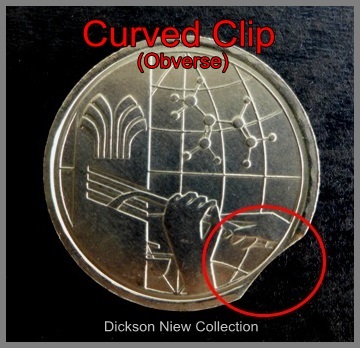
MALAYSIA COMMEMORATIVE COIN WITH CURVED CLIP PLANCHET ERROR

Malaysia 1977 100th Anniversary Of Rubber Commemorative Ringgit Coin With Curved Clip Planchet Error.
Rarity: RRR
Very thankful to Mr. Anthony Tan of Monetarium Singapore for giving me the chance to inherit his collection of this rare Malaysia 1977 100th Anniversary Of Rubber Commemorative Ringgit Coin with Curved Clip Planchet Error.
This is a 1 Ringgit Copper-Nickel commemorative coin, weight measured at 16.80gm with a diameter of 33.40mm and 2.45mm on thickness. It was issued in 1977 with a total mintage of 500,000 pieces. Minted by Franklin Mint.
A clipped planchet or edge bite error coin occurs when a coin is struck on an incomplete planchet. Coin blanks are punched out from strips of metal using a high-speed punch. Sometimes the strip isn't pushed along far enough after the previous blank was punched and this results in a planchet that isn't fully rounded. The resulting planchet has been punched out of the strip where the previous blank was cut, thus leaving a 'bite' out of the blank.The resulting coin after it has been through the minting press has a curved clip on the side of the coin.
This a curved clip errors. Many curved clip error coins are faked by punching the curved clip out with a punch. Collectors should take time to learn the diagnostics of this curved error due to the ease and frequency in which they are faked.
To distinguish between a genuine clip and a man-made version you need to look at the opposing edge of the coin. In genuine edge bites there is a weakness in the rim and on the opposing side of the coin - this is termed the 'Blakesley effect' after an American numismatist who first described it. The weakness results from the rim opposite the clip not being formed fully when it is put through the rimming machine.

Few diagnostics for genuine rim curved clips are:

1. The pole opposite the clip often shows a weak or absent rim. This is the "Blakesley" effect. Special Note: The "Blakesley" effect is not always seen on coins with authentic curved clips which are LARGE.
2. Design elements bordering the clip often show metal flow -- a smearing and stretching out of the design.
3. The exposed edge of the clip will usually show a "belly line" or "breakaway zone". Half of the exposed edge (upper or lower half) will be grainy and the other half smooth.
4. The rim should fade out and taper toward the clip. The Blakesley Effect is a term used to describe inefficient metal flow, opposite a clip on a coin ( "opposite a clip on a coin" it means the effect will be more or less CW/CCW180 degrees around the rim) from the clipped area., when the rim is formed and the subsequent imperfect or incomplete rim formed at that position after striking.

Happy Niewmismatics !!

MALAYSIA ROYAL MINT UK 1971 $1.00 COIN WITH LAMINATION ERROR

Malaysia Parliament House Series 1971 $1.00 (ROYAL MINT UK) Coin With Planchet Lamination Error.
Rarity: RRR

A lamination flaw is a planchet defect that results from metal impurities or internal stresses. Lamination flaws cause discoloration, uneven surfaces, peeling, and splitting. A lamination is a planchet defect caused when a portion of the planchet metal separates from itself due to impurities or internal stresses.

Lamination flaws occur primarily when foreign materials or gas become trapped within the planchet metals as they are being formed. They can be minor or major.
To prepare planchets on which to strike coins, the mint purchases rolls of metal of the correct composition and thickness of the coin to be produced. These rolls are fed through a blanking machine that punches them out into the metal disks on which the coins are struck, which are known as blanks. At this stage, the blanks are go into an upending mill, which gives the blanks an upended rim or upset rim, which is where the rim becomes slightly raised and rounds off to the center of the blanks. Blanks with upended rims are called planchets. A planchet that escapes getting struck (without upending) is known as a blank.

Small laminations are fairly common and do not command a high premium. The larger the lamination and the larger the denomination of the coin, the higher value of the lamination.
Most clad layers are missing before the coin was struck. Coins with missing clad layers are not easy to find. They are not rare, but they are not common. This is why they are in demand.

The key to determine if this is a true error and not plated after it was struck is to weigh the coin. A Copper- Nickel $1.00 of Malaysia Parliament House Series is weight at 17.00gm. A missing a layer with lamination error will weigh less than 17.00grams. In addition, the fine detail should be missing, as well as parts of the letters close to the rim should be weak or mushy.

This is a Royal Mint UK minted Copper- Nickel $1.00 coin of Malaysia Parliament House Series.

The well known Malaysia senior numismatist Mr Saran Singh, the author of world famous "THE ENCYCLOPEDIA OF THE COINS OF MALAYSIA, SINGAPORE AND BRUNEI 1400-1967", mentioned in his book (second edition), our Malaysia very first One Ringgit copper-nickel coin was issued in the year of 1971. Weight:17.00gm, Diameter:33.9mm with total Mintage of 2,378,995 pieces.

However,500,000 pieces was minted by Royal Mint in UK.

Do you know how to differentiate a Malaysia 1971 one ringgit coin minted by Royal Mint of UK or Royal Mint of Malaysia?
Top Coin: Minted In Malaysia.
Bottom Coin: Minted In UK.
1)  Royal Mint of UK, with Clear and Neat Strikes on the Lettered edge.
2)  Royal Mint of UK,on the lettered edge,in the wording of "Malaysia",the alphabet "M" are different from the local mint.The center -V shape of the alphabet "M" are taller on the London Mint than the local mint.
3) Royal Mint of UK ,in the wording of  "Malaysia",the alphabet "S" are also different from the local mint.The alphabet "S" are taller on the London Mint than the local mint.
http://dniewcollectors.blogspot.my/2011/02/coin-story-malaysia-one-ringgit-year.html