Showing posts with label Die Errors. Show all posts

MALAYSIA ROTATED DIE STRIKE ERROR COIN

Malaysia Parliament House Series 1988 20 Cents Coin With CW 180 Degrees Rotated Die Strike Error.
Rarity: RRR
Rotated Die Error (CW180 degree upset)
One of the interesting minting varieties that escapes most collectors is the Rotated Die Error—yet it is the easiest to spot if you remember to look for it.

There are three basic causes:
A loose set screw that allows the die to turn in the holder;
A broken die shank that allows the die face to turn; and
A misalignment due to the die being installed improperly.
The loose screw is blamed for most of the early rotations, with the other two causes dividing up a minority of the rotations.
Rotated Die Error coin is produced during minting when the dies for the reverse and obverse of the coin are not aligned correctly. This may be because it was incorrectly installed in the press or it rotated during the production run of coins.

For Malaysian coins if you hold the reverse of the coin upright with a thumb and forefinger on the top and bottom edge you should be able to rotate the coin around to view the obverse which will be upright also. Malaysian coins are minted in what is known as ‘medal alignment’ -the back and front or heads and tails are both upright when viewed.

Coins from other countries such as the USA for example mint their coins in what is known as ‘coin alignment’. This means if you hold the reverse of a ‘coin alignment coin’ (such an an American quarter) upright and rotate the coin around to view the obverse it will be upside down (in contrast to Malaysian coins).

A regular coin should have the Parliament House, the crescent moon and the 13 pointers star on the obverse position at a right position. During minting one of the dies might not be aligned correctly or might rotate during the production run. When turning the coin around, if a coin is an upset it will show the reverse (denomination’s side) will be upside down . She may be leaning over to the clockwise (CW) right 90 degrees (a CW90 degrees upset) or upside down/ inverted (CW180 degree upset). You may find these upset errors in any number of degrees of the clockface.

If one side of the coin is only rotated a small amount, up to say 15 degree (or 1 o’clock position) it won’t be considered a rotated die error coin. This angle may be considered normal as there is a small allowance (tolerance) for slight angle movement in the struck coin.

A Rotated Die Error coin will demand a premium over it’s regular counterpart. The degree of upset will also determine how collectable it is. A Malaysia Parliament House series 50 sen coin  upset with a 90 degree angle may fetch RM150 or more depending on it’s condition so it’s worth looking out for this error in your change.

A Rotated Die Error Coin with a high degrees of  rotation will certainly command a higher premium as they are much less common.

MAJOR DIE BREAK ERROR-THE "CUD"

Malaysia Bunga Raya Series Coins 2005 VS 2009 10 Coins With "CUD" Error.
Rarity:RRR
Reverse
Obverse
A "Cud" Error on a Coin
Error coins sometimes show a raised, unstruck area resulting from a break in the die, which is known as a "cud" mark and it touches the rim.
A cud is a damaged area resembling a blob on the surface of a coin which is raised above the field, and which obliterates the device or inscription where it appears. Cuds are the result of die cracks which have become severe, or from die chips where part of the die surface has become damaged and broken away.
Some collectors in the error-variety hobby insist that for the blob to be called a "cud", the damaged part of the die must include part of the edge of the die. Although this is the purist definition, in common parlance you'll see the term "cud" used to describe the blob created by any die chip or serious die crack, regardless of its placement on the die or coin.
Very small cuds are not usually valuable unless they appear on Proof coins. Cuds which can be seen by the naked eye are usually worth a small premium over normal value.

However a major die break with a big "CUD" can command a good premium. I have came across more than 10 pieces of Malaysia Bunga Raya Series 2005 10 sen with a similar major "CUD" at 7 to 10 o'clock position on the reverse. It is a very good specimen of a "CUD" error coin.The cud on the Bunga Raya 10 cents 2005 coin  in our picture is quite spectacular. If you look closely, you can see the effects of the die break on the obverse (front side) of the coin.
Read more: http://dniewcollectors.blogspot.com/2011/10/major-die-break-or-cud-errors.html#ixzz3TKtEyeCo

MALAYSIA 1992 50 SEN WITH "SEPAL" VARIETY

Malaysia Bunga Raya Series 1992 50 Sen With "Sepal" Variety.(Die Chip Error).
Rarity:RR

The Malaysia Bunga Raya 1992 50 Cents with "Sepal"(Kelopak Daun) variety was introduced to me by Sifu Tony Au. This is first of the Bunga Raya Series coin that was known to me with variety. A Die Chip Error variety.
 
Die Chips Definition
If part of the die chips out, showing as a raised, unstruck area on the coin, it is called a chip.
A small piece (less than 4 square millimeters) that falls out of the die face and has no direct connection to the design rim. The missing piece leaves a void in the die face into which coin metal flows. As a result, the coin shows a featureless lump in the affected area.
A die chip can be connected to a die crack or it can be freestanding.

Die chips frequently develop within narrow interstices in the design.
A die chip is similar to a cud, but it can be very small and occur anywhere in the die, not just the edge.


http://dniewcollectors.blogspot.com/2013/09/coins-of-malaysia-die-varieties-and.html
http://dniewcollectors.blogspot.com/2013/10/coins-of-malaysia-die-varieties-and.html

MAJOR DIE BREAK "CUD"

Malaysia Bunga Raya Series 1 Sen 2006 With Major Die Break Error, The "CUD".
Rarity:RRR
Collectors more often than not refer to a major die break under the slang term "Cud." The term has it roots in the early error-variety hobby when the use of nicknames was more prevalent than today. This is one of the few slang terms that has stuck. No matter what you want to call it, a Major Die Break or "Cud" always involves a breakage of the die that includes a portion of its shank and field and or design areas. In other words, it will involve a section of the die from its edge large enough to include some of the face of the die that has broken and fallen away or has been retained.
Cuds are often confused with die breaks or even die chips that are found within the interior of the coin design but have no connection to the shank of the die or edge of the coin. A die break -- no matter how large -- that does not involve the edge of the die is not a cud -- it is simply a die break which may be defined as a Small Die Break or Large Die Break.
Some collectors, through plain ignorance or for monetary reasons (because the term "cud" seems to imply greater value) will sometimes refer to these as "interior cuds." The fact is, the error-variety hobby agreed decades ago that if a die break occurs anywhere away from the edge (or neck of the die) within the field of coin design it is NOT a cud.
Sellers, inventing new terms to replace perfectly good, traditional terms are not going to make simple die breaks into cuds! Another term we've seen come into use in recent years is interior die break. Unless a die break is defined as a Major Die Break or a Collar Die Break or a Rim Die Break, etc., it is implied to be a die break found within the die face. Specialists got along for decades understanding perfectly well what the term "die break" meant and there is no need to start modifying this term now. If you do not understand the terms, you need to buy some books and read them -- it's that simple! Of course if you do decide to use the term interior die break anyway it should cause little confusion but it is unnecessary.

M3S 20 CENTS "DOT" DIE GOUGE ERROR

Malaysia 3rd Series 2014 20 Cents With "Dot" Die Gouge Error.
Rarity:RR
Die gouges (or dents) are common on coins and like finding angels in the clouds, you will find them where you want if you look long enough.

These are raised thick bulges, usually on the fields of a struck coin (although they may occasionally be seen on the design), which are created by the striking of a hard object against the die.
A "DOT" or "DOTS" on a coin actually is a Die Gouge Error coin. Die Gouge Error is a form of die error when the hammer die struck through a small round object on the bottom die during the striking , thus creating a hole. This hole, which is an incused element on the die will result in a raised element on the subsequent coins came into the minting press. It was started as a tiny gouge on the working die but it was not rectify.The continuous usage of the die with die gouges formed dots on the coins.The "DOTS" enlarged and became bigger and bigger until it can be seen with a naked eyes.
A Malaysia (M3S) 2014 20 Cents exhibited a "Dot" on a petal of the hibiscus flower at the 4 o'clock position on the reverse. 

Gentle Reminder!!
Special Links:
Malaysia Numismatic Society Auction No.162  21st December 2014.Kuantan Pahang.Special Preview.Lot: 1 to 260.
I have posted a series of auction items that were listed in our MNS Auction No.162 which to be held on 21st December 2014.For details, please visit:
http://dniewcollectors.blogspot.com/2014/11/mns-auction-no162-kuantan-lot1-to-lot.html
http://dniewcollectors.blogspot.com/2014/11/mns-auction-no162-kuantan-lot51-to-lot.html
http://dniewcollectors.blogspot.com/2014/11/mns-auction-no162-kuantan-lot101-to-lot.html
http://dniewcollectors.blogspot.com/2014/12/mns-auction-no162-kuantan-lot151-to-lot.html
http://dniewcollectors.blogspot.com/2014/12/mns-auction-no162-kuantan-lot201-to-lot.html
http://dniewcollectors.blogspot.com/2014/12/mns-auction-no162-kuantan-lot231-to-lot.html
Please note that this Auction will be held at:
Shahzan Inn Kuantan,
Lot Pt 240, Jalan Bukit Ubi/Jalan Masjid,
25000 Kuantan, Pahang Darul Makmur.

1970 CENT WITH ROTATED DIE ERROR

Malaysia Parliament Series 1970 Cent Coin 
With Rotated Die Error.
Rarity:RRR

Last Sunday, when I was in Amcorp Mall attending appointments. I happened to collect this rare date 1970 1 sen Malaysia Parliament series copper coin with a Clockwise 45 degree Rotated Die Error.

Being an error coin enthusiast collector since 2007, this is my first encounter with such rare date 1970 sen with an error. And it is a brilliant uncirculated (BU) coin in condition.
Obverse 45 degree clockwise rotated.
Obverse:45 degree clockwise rotated.

What is the Die Rotation on a Coin?
Definition: Die rotation refers to the location of the coin's image when the coin is turned over. For example, if you look at the obverse of our Malaysia Parliament series 1 sen coin with Parliament House right-side up, and then turn the sen over from left to right (or right to left), the denomination 1 should be right side up on the reverse. This is called "coin alignment." Normally, a coins design is upright on both sides when the coin is flipped over. A ROTATED DIES error is when the reverse die is not aligned properly with the obverse die. 

This type of error can be easily identified by holding a coin at the 12-o'clock and 6 o'clock position between your thumb and forefinger, looking at the obverse design upright, and flipping over from side to side, i.e. left to right or right to left. If the design on the reverse isn't upright (looks rotated either clock-wise or counter clock-wise), you've found a rotated-dies error. Some rotated dies can be quite dramatic, some even a perfect 180 degrees! With some searching, they can be found in pocket change.

Rotated die coins usually occur in two different ways, the first being the mint employee installs the die incorrectly so the obverse and reverse do not line up properly when the coin is struck and the second is when the die becomes loose and then moves a little bit as each new coin is struck.

All Malaysia coins, and nearly all world coins, are struck in one or the other of these proper die alignments. Die rotation errors are known to exist, where the coin's reverse isn't precisely lined up with the obverse. Many Malaysia coins have been found with die rotations ranging from a few degrees off, to a full 180 degrees off!

KEY DATE COIN 1994 20 CENTS ROTATED DIES ERROR

Malaysia Bunga Raya Series 1994 20 Cents Coin With Rotated Dies Error.
Rarity:RRR/UNC
Malaysia 1994 20 Cents was rated as one of the key date coin in Bunga Raya Series. It was minted with a total mintage of 2,680,339 pieces only.This total amount of mintage is one of the lowest on 20 cents in Malaysia Bunga Raya Series.

It was minted on a Copper-Nickel planchet, weight at 5.66gm, its diameter is 23.59mm and with a thickness of 1.75mm.

A  piece of uncirculated 1994 20 Cents was priced at RM650 on the current market in Kuala Lumpur. Just two months ago it was sold at RM450 only. If you have a piece graded by NGC or PCGS with MS67 in Gem Uncirculated grade, the selling price will be unimaginable!

This is a piece of  Malaysia 1994 20 Cents key date coin struck with Rotated Dies Error.
Normally, a coins design is upright on both sides when the coin is flipped over vertically. A ROTATED DIES error is when the reverse die is not aligned properly with the obverse die. This type of error can be easily identified by holding a coin at the 3-o-clock position between your thumb and forefinger, looking at the obverse design upright, and flipping in over vertically. If the design on the reverse isn't upright (looks rotated either clock-wise or counter clock-wise), you've found a rotated-dies error.
Rotated Dies Error can be caused by two reasons :
1-One of the die was improperly aligned during the installation.
2-One of the die was too slack during the striking process and turned on its axis.

There are regularly rotated coins in circulation. Pivoting movements of less than fifteen degrees are in the standards mint and have no added value.

Some Rotated Dies Error can be quite dramatic, like this rare 1994 20 Cents coin with a perfect 180 degrees!

Rotated Dies Error coin can be an exciting and profitable error to collect. Watch your change,you may have something more interesting than you think. With some searching, they can be found in pocket change.

THE BROTHER AND SISTER OF MAJOR DIE BREAK, THE "CUDS"

Bunga Raya Series.The "CUDS" Brother and sister.
Rarity: RRR/UNC
On 29th April 2011, I posted an article entitled "MALAYSIA COIN DIE ERRORS:TWIN BROTHERS OF MAJOR DIE BREAK OR "CUD" ERRORS(Read more: http://dniewcollectors.blogspot.com/2011/04/malaysia-coin-die-errorstwin-brothers.html#ixzz2kWzNtWig).
Today I found an other brother and sister for "him". The Brother is a 2004 one cent coin and the sister is a 2005 5 cents coin. Both coins with Major Die Break Error "CUD" and occured on the same position similar to their twin brothers.There is 7 o'clock to 10 o'clock position on the reverse.
What is a Cud on a Coin? 
Cuds are the result of die cracks which have become severe where part of the die surface has become damaged and broken away. A cud is a damaged area resembling a blob on the surface of a coin which is raised above the field a little, and which obliterates the device or inscription where it appears.Some experts in the error-variety hobby insist that for the blob to be called a cud, the damaged part of the die must include part of the edge of the die.
Very small cuds are not usually valuable unless they appear on Proof coins. Cuds which can be seen by the naked eye are usually worth some premium over normal value.
How a Major Die Break Errors or a "CUD" can happens?
Coins are made by minting machines that apply tremendous stamping pressure to pieces of metal, leaving artistic patterns in the finished coin. The piece of metal, or coin blank, is called a planchet, and the hardened patterns that stamp on the coin are called working dies. There are two dies in a minting press, one die for the Obverse, and one die for the Reverse of the coin. After hours and hours,days and days of coin striking, the dies sometimes break under the pressure. Mint workers usually replace the dies before they crack, but sometimes several coins are produced before the workers find and replace the dies. If the broken dies go unattended for long periods of time, the break grows worse and worse, leaving larger and larger malformations on the struck coins. A large lump of coin metal left by a major die break is called a "CUD".

1982 5 CENTS WITH EXTRA TWO "DOTS"

Malaysia Parliament House Series 1982 5 Cents Coin With Extra Two "DOTS".
Rarity:RRR
On 28-5-2012, I had posted an article on my Blog about FORGERY DOT ON 1982 5 CENTS,
then on 12-6-2013, I wrote an other article about FORGERY DOT ON 1982 5 CENTS-UPDATES followed by 11-8-2013,one more article about this Malaysia Parliament House Series 1982 5 Cents
i.e.POST MINT JOB ERROR ON 1982 5 CENTS STAR.
On 29th September 2013, in our Malaysia Numismatic Society Auction 157, this "Dot Variety" item was sold at a realised price of RM320.It was bidded by a very senior collector.
Reference:
Malaysia Numismatic Society Auction No.157  29th September 2013. Museum Negara.Special Preview.Lots:102 To 125.
103    1       Malaysia 5 Cents 1982 (dot variety)                UNC        160
                                                                                  Realised: RM 320
Read more: http://dniewcollectors.blogspot.com/2013/09/mns-auction-no157-lot102-to-lot-125.html#ixzz2hYbirMEb
Here, I would like to share with you a similar 1982 5 Cents  "Dot Variety"  but instead of one "DOT", it has two "DOTS".One "DOT" is located at its usual location, on the building of the Parliament House.An other "DOT" was found near the star with the new moon.
Actually, it was the derivation of a Die Gouge.It was started as a tiny gouge on the working die but it was not rectify.The continuous  usage of the die with die gouges formed dots on the coins.The "DOTS" enlarged and became bigger and bigger until it can be seen with a naked eyes.

If you have a uncirculated piece of 1982 5 Cents with "DOT", put them under 10 times magnifying glass, you should be able to spot some small tiny patches of "DOTS" next to the "DOT" on the building of Parliament House and more tiny "DOTS" near the new moon and the star, few more tiny "DOTS" above the base of the building on the right.
The second "DOT" on my 1982 5 Cents coin,it was the enlargement of one of the tiny "DOT" near the star.It happened when the broken dies go unattended for long periods of time, the Die Gouge grows worse and worse, leaving larger and larger malformations "DOT" on the struck coins.

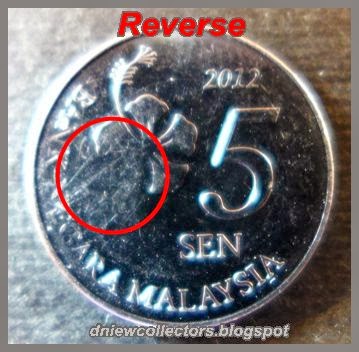
2012 5 CENTS FILLED DIE ERRORS

Malaysia 3rd Series (M3S) 2012 5 Cents Coin With Filled Die Errors
Rarity:RR
Over-polished dies examples are missing part of the coin's normal design. They also display "abraided" die characteristics (from over-use) because these Mint Errors were the result of the extended  life of the working die, to save money. So mint employees would file and polish the dies. Often, this resulted in some areas of the die to be poorly struck and missing certain parts of the coin's design.
Most Filled Dies on all denominations of coins are very common and coin struck from a  filled die will be released from the Mint, as the Mint does not consider these as errors.Filled dies error coins occurs because of the huge volume they mint each year.There are some collectors who like an example of their favorite coin with a  filled die, but I always like to suggest to them to find such minor error coins in circulation themselves.
A filled die coin is a very common form of minor error and does not add significant numismatic value to the coin. This would have approximate retail value of between RM15.00 to RM 38.00 to an interested error coins collector,depending on the date,denomination and condition of the error coin.

2012 50 CENTS -"CUD" ERRORS

Malaysia 3rd Series(M3S) 2012 50 Cents With Major Die Break Errors-The "CUD"
Rarity:RRR
Major Die Break Errors: The "Cud"
The image below is an example of a 2012 M3S  50 Cents that has a major die break, often referred to as a "Cud".
"Cuds" are a type of Major Die Break Errors. When an area or part of the working die breaks off, a big gap on the working die's surface is created. The coins struck by these dies display a raised blank section which we always reffered to as a "Cud".
To check its authenticity, the portion of the reverse of the coin opposite the cud will be struck weakly due to the lack of counter-pressure.
A major die break error can only be called a "CUD" if the break occurs  attach to the rim of the die. Otherwise, they are just simply referred to as a "die break". Sometimes the die break will not fall off completely, and the resultant strikes are referred to as "retained cuds".

How a Major Die Break  Errors or a "CUD" can happens?
Coins are made by minting machines that apply tremendous stamping pressure to pieces of metal, leaving artistic patterns in the finished coin. The piece of metal, or coin blank, is called a planchet, and the hardened patterns that stamp on the coin are called working dies. There are two dies in a minting press, one die for the Obverse, and one die for the Reverse of the coin.
After hours and hours,days and days of coin striking, the dies sometimes break under the pressure. Mint workers usually replace the dies before they crack, but sometimes several coins are produced before the workers find and replace the dies. If the broken dies go unattended for long periods of time, the break grows worse and worse, leaving larger and larger malformations on the struck coins. A large lump of coin metal left by a major die break is called a "CUD".