Showing posts with label STRIKING ERRORS. Show all posts

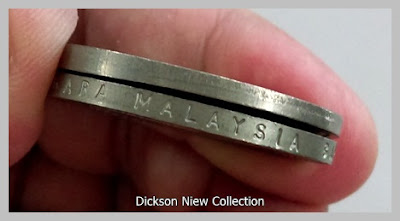
MALAYSIA 1971 $1.00 COIN WITH PARTIAL LETTERED EDGE ERROR

Malaysia Parliament House Series 1971 $1.00 Coin With Collar Die Strike Error.
Rarity:RRR
This is a piece of  1971 Parliament House Series $1.00 Copper-Nickel coin that I found without perfect lettered edge.

It only exhibits about 14 % of the inscription " BANK NEGARA MALAYSIA-BANK NEGARA MALAYSIA". The edge lettering should be incused (sunken in,) and run all the way around the edge of the coin.

This piece was minted by our Shah Alam Mint because the alphabet "M" in the wording "MALAYSIA" , the center "V" shape of the alphabet "M" is shorter.

Top Coin Minted In Malaysia.
Bottom Coin Minted In UK.

Read more: http://dniewcollectors.blogspot.com/2011/02/coin-story-malaysia-one-ringgit-year.html#ixzz4KF60itWa
Those minted at the Royal Mint of UK, the wording of "Malaysia" on the lettered edge, the alphabet "M" are different from the local mint. The center -"V"  shape of the alphabet "M" are taller on the London Mint than the local mint.

Malaysia Parliament House Series 1971 $1.00 Coin With Collar Die Strike Error.
 
Read more: http://dniewcollectors.blogspot.com/2011/02/coin-story-malaysia-one-ringgit-year.html#ixzz4KEsNOyKkbr />
http://dniewcollectors.blogspot.my/2015/11/malaysia-1971-one-dollar-coin-without.html

MALAYSIA PARLIAMENT HOUSE SERIES 5 SEN COIN (1967-1988) WITH FULL BROCKAGE STRIKE ERROR

Malaysia Parliament House Series 5 Sen Coin (1967-1988) With Full Brockage Strike Error  

Rarity:RRR

What is a Brockage Strike Error?
Many coin enthusiasts, find Brockage Strike Error coins to be among the coolest kinds of error coins.
A Brockage Strike Error coin about in a process that involves more than one event.

First, a coin must be, for one reason or another, not ejected or otherwise removed from a mechanical coining press. Accidentally, it remains on one of the dies.

Second, while a coin remains on one of the dies, the next planchet (prepared blank) is fed into the coining press and the striking process occurs again. This next planchet then becomes sandwiched between an already struck coin and one of the two dies.
Third, if the design devices on one side of the already struck coin become imparted onto one side of the next fed planchet (prepared blank) and if the other side of this planchet is struck by a die in a normal manner, then a brockage comes into existence. In a sense, a brockage has an obverse design on both sides (or a reverse design on both sides).
For simplicity, I refer to the typical situation where the hammer die, the one that is slammed downward, is the reverse (back) die and the stationary or minimally moved die (underneath each fed planchet) is the obverse (front) die.
The type of brockage that is most often seen is an reverse (back) brockage that comes about after a struck coin fails to leave the press and lies on top of the bottom die that is the obverse (head) die. When the next planchet (prepared blank) is fed into this press, it falls on top of the coin that was not ejected or otherwise removed, and then the ‘hammer’ die comes smashing down on top of this planchet (prepared blank), which is thus sandwiched between an already struck coin and an reverse die.
The reverse die imparts, in a normal manner, an reverse design to the reverse of this planchet that was fed into the press even though a struck coin had not left the press. The leftover coin, however, is ‘in between’ the obverse die and this planchet that was fed. Therefore, a obverse design is not imparted, as the obverse die is covered by the leftover coin. Instead, the reverse of the leftover coin is impressed into the underside (obverse) of the planchet.
Therefore, an incuse (sunken) and ‘backwards’ transformation of the reverse design is imparted into the underside (‘obverse’). The newly created error has a normal obverse and an incuse and backwards version of the reverse design as its ‘obverse’!

MALAYSIA COMMEMORATIVE COIN WITH STRIKE THROUGH ERROR

Strike Through Error On A Malaysia Commemorative Coin 1980
Rarity:RRR
In any manufacturing process there are bound to be mistakes made. Both human and mechanical errors occur on an irregular basis, resulting in defective products. In most industries these bad parts are caught by quality control inspectors or by the persons responsible for packaging the finished products. When spotted, these rejects are simply destroyed. If they succeed in eluding detection, the customer who receives the erroneous part will likely return it for a refund or exchange. But what happens when the defective item is money?
ONE RINGGIT (COPPER-NICKEL) COMMEMORATIVE COIN OF 15TH CENTURY OF HIJRAH-1401 HIJRAH.1980

Struck Through Errors
What is a “strike through” error? Simply put, it is anything which is struck into the coin, but which was not “retained” in the strike. If the item was retained, it would be termed “struck through and retained (fill in the blank).”
Coins have been found struck through buttons, wire, grease, plastic, tape, cloth, washers, sanding paper, other planchets, struck coins, foreign coins, fragments of other coins, springs, and numerous other things.

Where do all these things come from so that they can be struck into the coins? Well, the mint’s are factories, with lots of equipment made up of thousands of parts, machines dripping grease, bolts, screws, and random debris, and so there are lots of things which could break off, come loose, or accidentally be fed into a press striking coins.
One of the most important things in a strike through’s collectibility is if the item or substance struck into the coin can be identified. Most of the time this is easy, but it can also be difficult since things struck into the coin have a habit of getting badly distorted by the strike. If it cannot be determined, it falls into the most basic and uninteresting description “struck through”, which means that the coin was struck through something, but what is unknown.
In this case, it was a piece of wire!

http://dniewcollectors.blogspot.my/2013/11/1969-50-cents-strike-through-error.html

MALAYSIA 1971 ONE DOLLAR COIN WITHOUT EDGE LETTERING STRIKE ERROR

Malaysia Parliament House Series 1971 $1.00 Without Edge Lettering Strike Error.
Rarity:RRR
First of all, a normal edge lettering appearance is for a business strike (circulation issue) Malaysia 50 Cents or RM1.00 coin. The edge lettering should be incused (sunken in,) and run all the way around the edge of the coin.
It doesn't matter whether the heads or tails side is facing up on business strike 50 Cents or RM1.00 coin because the edge lettering is applied randomly, so a coin with upside down edge lettering is NOT an edge lettering strike error! It is simply a normal variety.
This is a piece of  1971 Parliament House Series $1.00 Copper-Nickel coin that I found without the edge lettering.

 
Absent Edge Lettering Strike Error Definition:
This error occurs when a 1971 Parliament House Series $1.00 Copper-Nickel coin bypasses the edge lettering device or when the spacing between the lettering die and impeller wheel becomes too generous.
Note: Edge lettering and other edge design elements may be impressed during upsetting, during the strike, by a special machine before the strike, or by a lettering device after the strike. Similar-looking defects can occur in each of these processes. Any edge design that forms a closed interlock between the edge of the coin and the collar cannot be produced during the strike since that will prevent ejection of the coin after the strike.

The diagnostics for authentic of a Malaysia Parliament House Series $1.00 coin missing its edge lettering are as follows:
1. Diameter should be 33.90 mm. Coins altered outside the mint will have a diameter that is less than 33.90mm and will have a diameter of approximately 32.00mm.

2. The coin’s weight should be approximately 17.00gm ± .03 g. Altered coins will weigh less from the removal of the edge lettering. Weights of approximately 15.00-16.00gm are commonly seen on altered coins.
3. An unaltered Malaysia Parliament House Series $1.00 coin with Absent Edge Lettering Strike Error will have no lines along the edge. Altered coins will normally have horizontal lines. These horizontal lines are from milling or similar machines used outside the mint to remove the letters and are the after effects of the metal being abraded off the coin.

Happy Niewmismatics !!

MALAYA QUEEN ELIZABETH II 1961 50 CENTS WITH MILLED EDGE.

Malaya & British Borneo Queen Elizabeth II 1961 50 Cents Without Security Edge
Rarity:RRR

This is the ever-popular 50sen coin dated 1961 from Malaya & British Borneo QE II  with a Milled/Reeded Edge, i.e. without security edge or we used to call it the Milled Edge (ME), instead of the usual one with the Security Edge (SE).This coin is in almost uncirculated condition.
It is a Edge Error Strike error coin.
Blanks are surrounded by collars when struck to prevent the blank from flattening and spreading. Edge errors occur when collars are either out of position or are deteriorated.

Countdown 9 days!!
Malaysia Numismatic Society Auction No.165  27th.September.2015 K.L. Special Preview.Lot:1 to 300
Muzium Negara, Jalan Petalawati,50480,Kuala Lumpur
http://dniewcollectors.blogspot.my/2015/09/mns-auction-no165-kllot1-to-lot-50300.html
http://dniewcollectors.blogspot.my/2015/09/mns-auction-no165-kllot51-to-lot-100300.html
http://dniewcollectors.blogspot.my/2015/09/mns-auction-no165-kllot101-to-lot.html
http://dniewcollectors.blogspot.my/2015/09/mns-auction-no165-kllot151-to-lot.html
http://dniewcollectors.blogspot.my/2015/09/mns-auction-no165-kllot201-to-lot.html 
http://dniewcollectors.blogspot.my/2015/09/mns-auction-no165-kllot251-to-lot.

FULL BROCKAGE STRIKE ERROR ON MALAYA QEII 50 CENTS (1954-1961) COIN.

Malaya & British Borneo 1954-1961 50 Cents Coin With Full Brockage Strike Error.
Rarity: RRRR
Mr. Tony, age 78  a very senior professional hotelier, found this undated Malaya British Borneo Queen Elizabeth II 50 Cents Copper-Nickel Coin with full brockage strike error during his early age. This coin has been in his custody for more than 45 years. He told me he kept the coin because it looks "funny".

The images above show an undated Malaya British Borneo 50 Cents Coin  (Queen Elizabeth II) with a full, early-stage brockage of the obverse design on the reverse face. It represents an early strike from an reverse die cap.
A brockage is an incuse, mirror-image version of the design. It is produced when a coin is struck into a planchet or another coin. A full brockage is one that covers the entire face (obverse or reverse). The coin carrying the brockage can be struck inside or outside the collar. The brockage can be complete or incomplete. The first impression of a coin is called a first-strike brockage. If the coin sticks to a die and becomes a die cap, it will strike additional planchets. These later impressions are called “early-stage”, “mid-stage”, and “late-stage” brockages.
The sharpest, most complete first-strike brockages occur when both the coin (the “brockage-maker”) and the planchet are confined by the collar. These “mirror brockages” are highly sought-after.


Malaysia Numismatic Society Auction No.165  27th.September.2015 K.L. Special Preview.Lot:1 to 300
Muzium Negara, Jalan Petalawati,50480,Kuala Lumpur
http://dniewcollectors.blogspot.my/2015/09/mns-auction-no165-kllot1-to-lot-50300.html
http://dniewcollectors.blogspot.my/2015/09/mns-auction-no165-kllot51-to-lot-100300.html
http://dniewcollectors.blogspot.my/2015/09/mns-auction-no165-kllot101-to-lot.html
http://dniewcollectors.blogspot.my/2015/09/mns-auction-no165-kllot151-to-lot.html
http://dniewcollectors.blogspot.my/2015/09/mns-auction-no165-kllot201-to-lot.html 
http://dniewcollectors.blogspot.my/2015/09/mns-auction-no165-kllot251-to-lot.html

MALAYSIA ROTATED DIE STRIKE ERROR COIN

Malaysia Parliament House Series 1988 20 Cents Coin With CW 180 Degrees Rotated Die Strike Error.
Rarity: RRR
Rotated Die Error (CW180 degree upset)
One of the interesting minting varieties that escapes most collectors is the Rotated Die Error—yet it is the easiest to spot if you remember to look for it.

There are three basic causes:
A loose set screw that allows the die to turn in the holder;
A broken die shank that allows the die face to turn; and
A misalignment due to the die being installed improperly.
The loose screw is blamed for most of the early rotations, with the other two causes dividing up a minority of the rotations.
Rotated Die Error coin is produced during minting when the dies for the reverse and obverse of the coin are not aligned correctly. This may be because it was incorrectly installed in the press or it rotated during the production run of coins.

For Malaysian coins if you hold the reverse of the coin upright with a thumb and forefinger on the top and bottom edge you should be able to rotate the coin around to view the obverse which will be upright also. Malaysian coins are minted in what is known as ‘medal alignment’ -the back and front or heads and tails are both upright when viewed.

Coins from other countries such as the USA for example mint their coins in what is known as ‘coin alignment’. This means if you hold the reverse of a ‘coin alignment coin’ (such an an American quarter) upright and rotate the coin around to view the obverse it will be upside down (in contrast to Malaysian coins).

A regular coin should have the Parliament House, the crescent moon and the 13 pointers star on the obverse position at a right position. During minting one of the dies might not be aligned correctly or might rotate during the production run. When turning the coin around, if a coin is an upset it will show the reverse (denomination’s side) will be upside down . She may be leaning over to the clockwise (CW) right 90 degrees (a CW90 degrees upset) or upside down/ inverted (CW180 degree upset). You may find these upset errors in any number of degrees of the clockface.

If one side of the coin is only rotated a small amount, up to say 15 degree (or 1 o’clock position) it won’t be considered a rotated die error coin. This angle may be considered normal as there is a small allowance (tolerance) for slight angle movement in the struck coin.

A Rotated Die Error coin will demand a premium over it’s regular counterpart. The degree of upset will also determine how collectable it is. A Malaysia Parliament House series 50 sen coin  upset with a 90 degree angle may fetch RM150 or more depending on it’s condition so it’s worth looking out for this error in your change.

A Rotated Die Error Coin with a high degrees of  rotation will certainly command a higher premium as they are much less common.

SPLIT LAYER PLANCHET AFTER STRIKE ERROR


Malaysia Parliament House Series 1983 50 Cents With Split Layer Planchet Error.
Rarity: RRR
Split Planchet After Strike usually depict full detailing.The result is usually a coin that is fully struck on one side with details and showing no striations,the other side will have a ghost of some design may or may not show a phantom strike due to pressure.

Split planchet errors are normally restricted to planchets comprised of a solid metal alloy including aluminum, bronze, nickel, & silver.
A split after strike planchet will always weigh less than a normal planchet. A fine to coarse striation pattern will be clearly evident on the face which splits away.

A Malaysia Parliament House series 1983 50 cent whose obverse face split off after being struck. Notice the reverse face has a strong strike. The entire Parliament House on obverse face is gone and instead only a muted,ghost image of the Parliament House building can be seen. This split layer error coin weight is 7.89gm (Normal: 9.33gm.), thickness is 1.59mm. ( Normal :1.90mm)
If the impurity is severe enough, it can case the planchet to split into two halves obverse and reverse. If the planchet splits before the strike, the resulting coin will be thin and have detail on both sides but often intermingled with rough striations from the impurities. If the planchet splits after the strike, one side will have full detail and the other side will be blank and have fine to coarse striation. In either case the coin will be thin.

2007 20 CENTS PLAIN EDGE COLLAR DIE STRIKE ERROR COIN

Malaysia Bunga Raya Series 2007 20 Sen With Plain Edge Collar Die Strike Error Coin
Rarity:RR
The collar is the third die in the coining chamber; a device which surrounds the edge of the planchet as the coin is struck. The collar die keeps the coin metal from spreading larger than its intended diameter. The collar die also imparts the edge design, if any, onto the struck coin. The edge design includes such elements as the reeds, words, symbols or other edge devices. Even the flat, smooth finishes on the edges of coins like cents and nickels are considered to be "edge designs" imparted by the collar die.We all know about the hammer and anvil dies. But we sometimes overlook the collar die and its significance in the coin-striking process, especially as it relates to the production of error coins.
It occurs when the collar die is stuck in the recessed position, usually due to a build up of grease and debris. In this instance, when a planchet is fed into the coining chamber, it rests on top of the anvil die with no collar in place to retain the strike. Therefore, the planchet is struck between the anvil and hammer dies only.
This 2007 20 Cents Plain Edge Error coins are coins somehow escaped the edge reeding process. To authenticate the coin, I scrutinized the edge closely and found it to be unaltered. The weight and diameter were checked and found to be within tolerance.

Read more: http://dniewcollectors.blogspot.sg/2013/03/1973-plain-egde-error-coins.html#ixzz3girZuDVV

2001 50 CENTS DIE ADJUSTMENT STRIKE COIN

Malaysia Bunga Raya Series 2001 50 Sen With Die Adjustment Strike Coin.
Rarity: RR
The die alignment is adjusted by the technician at the hammer or reverse die. Alignment is important in that the tolerances between the feeder fingers, the collar and the die are quite small such that too much initial offset could result in damage to any of the above. To avoid this, the technician runs trial strikes at reduced pressure to test his adjustments. Although intentionally made, any that escape the mint are considered errors and are called a “Die Adjustment Strike.”
Die Adjustment Strikes are also known as die trials. This error occurs when a coin is struck from the press with very little pressure. When the press is being set up and adjusted, extremely weak strikes occur as the strike pressure reaches its optimum level.The resultant coins are very weakly struck and are gathered up afterwards to be destroyed and are rarely found in circulation.
Shown here is an example that showing only approximately 75% detail . The key diagnostic in identifying these is that there is equal weakness on all two sides – the reverse, and the obverse. The Mint technicians are very careful to prevent these from escaping the Mint; however, occasionally one will find its way out.

2013 "200" CENTS OFF CENTER DOUBLE STRIKE ERROR COIN

Malaysia 3rd Series (M3S) 2013 "200" Sen (20 Cents) Off Center Double Strike Error Coin
Rarity: RRR
When a blank planchet is struck by the dies, the normal procedure is for the feeders to eject the struck coin out of the collar and into a chute. If there is a malfunction and the struck coin isn't ejected, it may receive a second or third strike by the dies. A multiple struck coin can happen in many ways and have many combinations of errors.
A planchet is feed into the coinage press and rest inside the collar on the anvil die. After being struck, the anvil die moves upward, raising the coin, the coin is suppose to exit from the coinage press and go to a collecting area.
If the coin was not eject properly after having been struck and falls partially inside the collar, it will be struck again. This is how we get the Double Struck Off-Center Error coins.
This is a piece of Malaysia Third Series coin with year dated 2013, 20 Cents Coin with Double Struck at 25% Off-Center Error. It exhibits a 200 sen on the reverse.